St. NicholasCatholic Primary School




‘Love one another, as I have loved you’
Our Early Years Foundation Stage (EYFS)
A very warm welcome to all of our new children and families joining St Nicholas Catholic Primary School!
Starting school is an exciting milestone, and we want every child to feel happy, safe and confident as they begin their journey with us. We work closely with children and their families before September so that we can get to know each child and make their transition into school as smooth and positive as possible.
What is the Early Years Foundation Stage?
The Early Years Foundation Stage is the period of education from birth to 5 years. In our Foundation Stage we have two Reception classes – Reception A and Reception B. Each Reception class consists of 22/23 children and allocated support staff across both classes. Both classes have their own carpet area for group time, but they then share the same areas of provision and outside area.
Our curriculum recognises children’s prior learning from previous settings, by liaising with nurseries and pre-schools prior to school entry, as well as their home experiences, by liaising with parents and observing the children prior to entry. We provide first hand learning opportunities, whilst allowing the children to build resilience, ambition and integrity.
Every child is a unique individual, we celebrate and welcome differences within our school community. We provide enhancement opportunities to engage learning and believe that school should be a happy and positive place, enabling children to develop a lifelong love of learning.
Before Your Child Starts
Once your child has been offered a place at St Nicholas, you will receive an individual new starter letter containing important information specific to your child, including:
- your child's start date and time for September;
- dates for our Stay and Play transition sessions during the Summer Term;
- information about your child's home visit;
- details of our New Parents' Meeting and other important transition arrangements.
Our Stay and Play sessions give children opportunities to spend time in their new environment, meet the adults who will be caring for them and begin to become familiar with the routines of school before September.
Home visits are another important part of our transition process. They give us an opportunity to meet your child in a familiar environment, begin building relationships and talk with you about your child before they start school.
If you are unsure about your child's place, start date or transition arrangements, or you think you should have received this information but haven't, please contact the school office. Our team will be happy to check the details for you and make sure you have everything you need.
Getting Ready for School
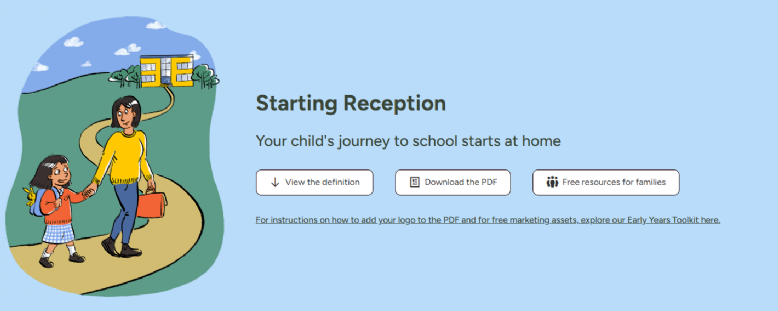
There are lots of small things you can do at home to help your child feel confident and ready for starting school. Developing everyday independence — such as using the toilet, washing their hands, brushing their teeth, getting dressed and managing their own belongings — can make a big difference as children begin Reception.
We have included some helpful, parent-friendly guides below covering starting school, toileting and toothbrushing. Please don't worry if your child hasn't mastered all of these skills before September — every child develops at their own pace, and we will continue to support them as they settle into school.
New Parents' Meetings
We invite our new families to a New Parents' Meeting before their child starts with us. This is an opportunity to meet members of the team, find out more about life at St Nicholas and ask any questions you may have.
At the meeting, families receive a New Starter Pack containing useful information to help you prepare for September, including:
- school uniform information;
- important school policies and procedures;
- photo and media consent information;
- Breakfast Club and After School Club information;
- advice about preparing your child for starting school;
- information about school meals and Free School Meals;
- key school information and contact details;
- and other forms and information you will need before your child starts.
Copies of key information and resources can also be found on this page.
So, what will my child learn?
Our EYFS Long-Term Plan sets out the key knowledge, skills, themes and experiences children will explore throughout their Reception year. Learning is carefully sequenced to build strong foundations across the seven areas of learning and support children towards the end-of-Reception Early Learning Goals.
We also have a Nursery Rhyme Spine, which sets out key rhymes for children to learn and enjoy. Songs and rhymes help develop children’s language, vocabulary, listening skills and early reading skills.
When children first join us, we spend time getting to know them and understanding their individual starting points. Through everyday conversations, play and observations, alongside information shared by families and previous settings, we find out what children already know and can do. We use this understanding to plan learning and provide appropriate support and challenge throughout Reception.
Children also complete the statutory Reception Baseline Assessment (RBA) within their first six weeks of starting Reception. This is a short, practical assessment covering early language, literacy and mathematics. Children do not need to prepare for it, and there is no pass or fail. It provides a starting point for measuring the progress of the school’s cohort between Reception and the end of Year 6; it is separate from our ongoing assessment used to plan children’s learning.
Our EYFS Long-Term Plan, Nursery Rhyme Spine and information for parents about the Reception Baseline Assessment can be found below.
The Early Learning Goals
During Reception, children learn through a combination of play, exploration, adult-led teaching and carefully planned experiences. The Early Years Foundation Stage (EYFS) sets out seven areas of learning and development which shape our curriculum.
The three prime areas are:
- Communication and Language
- Personal, Social and Emotional Development
- Physical Development
The four specific areas are:
- Literacy
- Mathematics
- Understanding the World
- Expressive Arts and Design
At the end of Reception, children's development is assessed against 17 Early Learning Goals (ELGs) across these seven areas. The Early Learning Goals describe the knowledge, skills and understanding children are expected to have developed by the end of the EYFS.
| Area | Early Learning Goals |
|---|---|
| Communication & Language | Listening, Attention & Understanding • Speaking |
| Personal, Social & Emotional Development |
|
| Physical Development | Gross Motor Skills • Fine Motor Skills |
| Literacy | Comprehension • Word Reading • Writing |
| Mathematics |
|
| Understanding the World | Past & Present • People, Culture & Communities • The Natural World |
| Expressive Arts & Design |
|
Children develop at different rates and in different ways. The Early Learning Goals are an end-of-Reception assessment and are not intended to be used as a checklist for children starting school. Our priority when children join us is getting to know them as individuals, building secure relationships and supporting them to become happy, confident and enthusiastic learners.
EYFS Framework and Guidance
Our Early Years provision is underpinned by the Early Years Foundation Stage (EYFS) statutory framework, which sets the standards for children's learning, development and care from birth to five.
Our curriculum and practice are also informed by national Early Years guidance, including Development Matters and Birth to 5 Matters, which support practitioners in understanding children's development and planning high-quality learning experiences.
Families who would like to explore the EYFS in more detail can access the relevant documents below:
Early Years Foundation Stage Statutory Framework
The statutory requirements that all Early Years providers must follow.
Development Matters
Non-statutory guidance supporting the delivery of the EYFS and children's learning and development.
Birth to 5 Matters
Additional guidance exploring children's development and effective Early Years practice.
Early Learning Goals
The 17 goals used to support assessment of children's development at the end of Reception (visible above).
Supporting Children with Additional Needs
We recognise that some children may need additional support or a more personalised approach to transition, and we want families to feel confident that we will work with them from the very beginning.
If your child has an identified special educational need or disability (SEND), or if additional needs are identified during our transition process, our Early Years and SEND teams will work closely with you to understand your child's individual strengths and needs.
Where appropriate, this may include:
- additional or individual transition visits;
- liaising with your child's current nursery or early years setting;
- a visit to your child's nursery to see them within a familiar environment and speak with the adults who know them well;
- additional meetings with parents and carers;
- sharing information with relevant professionals, with parental involvement;
- preparing photographs, visuals or other resources to help your child become familiar with school;
- planning any reasonable adjustments, provision or support your child may need when they join us.
Our dedicated SEND Team works alongside families, class teachers, Early Years staff and external professionals to ensure that children's needs are understood, and that appropriate support is in place.
Every child's transition may look slightly different. Our priority is to make sure that each child feels known, welcomed and supported as they begin their journey at St Nicholas.
Speech and Language
Supporting children's speech, language and communication development is an important part of our Early Years provision at St Nicholas.
As part of our approach to early identification, all children are offered a speech and language screening when they join us in Reception. This helps us to understand each child's communication strengths and identify at an early stage where a child may benefit from some additional support.
A consent letter for speech and language screening is included in your New Starter Pack, which you will receive at our New Parents' Meeting. We ask parents and carers to read, complete and return this form so that screening can take place once your child has started school.
Alongside this, all children in Reception benefit from whole-class NELI (Nuffield Early Language Intervention) activities, supporting the development of important communication, vocabulary and language skills as part of our universal Early Years provision.
Following screening, if we identify that your child would benefit from some additional support, they will initially receive an appropriate speech and language intervention in school, delivered by trained members of staff. We will monitor their progress carefully and keep you informed about the support they are receiving.
Where a child requires further assessment or more specialist support, we can seek advice or involvement from our Speech and Language Therapy partners, working closely with families throughout the process.
Early identification is really important to us. Speech, language and communication skills underpin so much of children's learning, relationships, confidence and ability to express their needs, and identifying difficulties early means that we can put the right support in place as soon as possible.Enter A Title
Early Reading and Writing
We want children to develop a love of books and the skills to become confident readers and writers. Daily stories, songs and rhymes introduce children to rich language, different characters and new ideas. Adults encourage children to join in, talk about stories and share their own thoughts.
We teach phonics through Read Write Inc., beginning in Reception. Children learn to recognise sounds, blend them to read words and use their phonics knowledge when writing. Regular assessments help us match teaching to children’s needs, and additional practice supports children who need more help.
Reading materials are sent home in line with each child’s current Read Write Inc. phonics group. These may include a sound book, a blending book, a ditty sheet or a reading book containing words and sentences. This ensures that children practise learning that matches their current phonics knowledge.
Children also bring home a family reading book to enjoy with an adult. Sharing these books supports reading for pleasure, develops vocabulary and gives families opportunities to talk about stories together.
Writing develops through drawing, mark-making, oral rehearsal and explicit teaching. Children build the physical skills needed for writing, learn letter formation and increasingly use their knowledge to write words and sentences. Our provision gives children meaningful reasons to write, such as making signs, lists, messages and labels.
Further information about phonics and supporting reading at home can be found on our phonics and Reception class pages.
Understanding and Sharing Children’s Progress
Assessment is part of everyday teaching and learning in Reception. Through conversations, observations, play and taught activities, adults find out what children understand, what they can do and what they need to learn next.
We use this information to adapt teaching, revisit learning and provide appropriate support and challenge. Regular phonics assessments help us ensure that children receive teaching matched to their current knowledge.
We use Tapestry, our online learning journal, to record and share observations of children’s learning. Parents and carers can also contribute photographs, observations and achievements from home. These contributions help us build a fuller picture of each child’s interests, experiences and development.
Parents’ evenings take place in October and March, providing opportunities to discuss how children have settled, their progress and their next steps. Families receive a mid-year report at the March parents’ evening. Additional meetings are held throughout the year for children with special educational needs and disabilities (SEND), so that families and staff can review progress and support together.
In July, families receive an end-of-year report detailing their child’s Early Years Foundation Stage Profile (EYFSP) outcomes, including their development against the Early Learning Goals. We also share information with Year 1 staff to support continuity in children’s learning.
Working in Partnership with Families
We recognise that parents and carers are children’s first educators. Strong relationships between home and school help children feel secure and support their learning and development.
Our partnership begins before children start school through our new parents’ meeting, transition visits and home visits. Throughout Reception, we encourage families to share information, ask questions and speak to us about any concerns.
We offer a range of opportunities for families to become involved in school life, including Stay and Learn sessions, parent workshops, craft activities, secret reader visits, class assemblies and praise assemblies. Families are also invited to join school celebrations and share cultural traditions and experiences that enrich children’s understanding of our community.
Our workshops and shared activities provide practical ideas for supporting children’s language, phonics, reading, mathematics, physical development and independence at home. Through Tapestry, families can see observations of learning in school and share children’s experiences and achievements at home.
Half-termly learning leaflets, vocabulary maps and home-learning guidance help families understand what children are learning and how they can support them. Current resources and details of Reception activities can be found on our Reception class page.
Moving on to Year 1
We carefully support children’s transition from Reception to Year 1 so that they feel confident and prepared for the next stage of their school journey.
Children visit their new classrooms, meet their Year 1 teachers and take part in shared activities. These experiences help them become familiar with their new surroundings, build relationships and understand what to expect.
Reception and Year 1 staff hold handover meetings to share information about each child’s learning, strengths, interests and support needs. This helps Year 1 teachers build on children’s achievements and provide continuity in teaching and care.
We also hold a parent information meeting about the transition from EYFS to Year 1. This gives families an opportunity to learn about the Year 1 curriculum, routines and learning environment, and to ask questions.
Where children need additional preparation or support, we work closely with families and our SEND team to plan an approach suited to their individual needs.
We know there is lots to think about when your child is getting ready to start school! We have brought together some useful links, guidance and resources to support you and your child as they prepare for Reception.
Below you will find information about school uniform, preparing your child for starting school, early learning and development, as well as a link to Chatterbugs Speech and Language Therapy, who work in partnership with our school to provide specialist speech and language support.
These resources can be used alongside the information provided in your New Starter Pack and throughout your child's transition to St Nicholas.
Useful Links