St. NicholasCatholic Primary School




‘Love one another, as I have loved you’
Computing
Our Curriculum Intent
At St Nicholas we are committed to providing a curriculum for all where every child grows:
- Academically
- Socially
- Morally
- In aspiration
- To be prepared for the next phase in their academic journey and be spiritually nourished.
To achieve excellence in all that they do in the knowledge that we love one another as God loves you.
We are committed to being a fully inclusive school, where all pupils are welcomed, valued and supported to succeed. We provide a broad and balanced curriculum for all pupils, underpinned by high expectations and a belief that every child can achieve.
Our first approach is always high-quality teaching, where the learning objective remains the same for all pupils. We do not routinely lower expectations. Instead, we focus on identifying and removing barriers to learning, adapting how pupils access the curriculum. For pupils working significantly below age-related expectations, learning is adapted so that they remain fully included in the same curriculum experiences, themes and contexts as their peers, while working towards personalised targets linked to their individual needs. Support is planned and reviewed through the school’s graduated approach of assess, plan, do, review, ensuring that provision is responsive, builds over time, and leads to meaningful progress and increasing independence.
Meet the Subject Leader
Inclusion
At St Nicholas, we are committed to being a fully inclusive school, where all pupils are welcomed, valued and supported to succeed. We provide a broad, balanced and ambitious Computing curriculum for all pupils, underpinned by high expectations and a belief that every child can develop the knowledge, confidence and skills needed to thrive in an increasingly digital world.
Our first approach is always high-quality teaching, where the learning objective remains the same for all pupils. We do not routinely lower expectations. Instead, we focus on identifying and removing barriers to learning, adapting how pupils access the Computing curriculum through:
-
Carefully planned scaffolding and step-by-step instructions.
-
Explicit modelling and demonstrations of computing skills, software and digital tools.
-
Visual examples, screenshots and video tutorials to support understanding.
-
Pre-teaching and reinforcement of key computing vocabulary.
-
Structured opportunities for discussion, collaboration and problem-solving.
-
Practical, hands-on experiences with a range of digital devices and technologies.
-
Flexible grouping, paired activities and targeted adult support.
-
Opportunities to explore, practise, debug and improve digital skills at an appropriate pace.
-
Additional challenges and extension activities to deepen understanding.
Where needed, pupils may demonstrate their understanding in different ways, including:
-
Verbal explanations and discussions.
-
Practical demonstrations of computing skills.
-
Digital creations, including animations, presentations, coding projects and multimedia work.
-
Screenshots, photographs and recordings of completed tasks.
-
Supported written responses or alternative recording methods.
-
Assistive technology and adapted digital resources.
For pupils working significantly below age-related expectations, learning is adapted so that they remain fully included in the same curriculum experiences, themes and contexts as their peers, while working towards personalised targets linked to their individual needs.
Support is planned and reviewed through the school's graduated approach of assess, plan, do, review, ensuring that provision is responsive, builds over time, and leads to meaningful progress and increasing independence.
All teachers are responsible for the progress and inclusion of all pupils in their class, and support staff are deployed to enhance access and promote independence, rather than replace teacher interaction.
EYFS Foundations
At St Nicholas, we believe that developing children's confidence and curiosity with technology begins in the Early Years Foundation Stage (EYFS). Our approach provides children with opportunities to explore, experiment and develop early digital skills through engaging, practical and play-based experiences.
Although Computing is not a standalone area of learning within the EYFS framework, it is incorporated into our wider curriculum, supporting children's development in areas such as Understanding the World, Communication and Language, and Personal, Social and Emotional Development.
Children are introduced to the foundations of Computing through exploring everyday technology, developing basic digital skills and beginning to understand how simple instructions work. These early experiences help children develop problem-solving skills, logical thinking, creativity and confidence when using technology.
Online safety is an important part of our EYFS provision. Children begin to develop an understanding of how to use technology safely and responsibly. Through age-appropriate discussions and activities, they learn about asking for help, recognising when something makes them feel uncomfortable, understanding personal information and treating others kindly online.
Our Computing curriculum follows the Kapow Primary scheme of work, supporting a progressive approach to developing computing knowledge and skills from Reception through to Year 6. These early foundations prepare children for Key Stage 1, where they build upon their understanding through programming, digital literacy and the purposeful use of technology.
Through meaningful experiences, we aim to nurture confident, curious and responsible young learners who are ready to explore the digital world safely and creatively.
Progression in Computing
Our curriculum is carefully sequenced so that pupils build knowledge and develop skills progressively over time. We use KAPOW to support curriculum design, drawing carefully on its progression of knowledge and skills to ensure learning builds securely from pupils’ starting points towards increasingly complex concepts and outcomes.
The scheme is not used as an off-the-shelf curriculum. Leaders and teachers carefully select, adapt and supplement its content to meet the requirements of the National Curriculum and the needs of our pupils. This includes adding our own learning where appropriate and considering pupils’ backgrounds, cultures, experiences and local context, ensuring that the curriculum is relevant, representative and ambitious for the children at St Nicholas.
Progression mapping is carefully applied across our mixed-age classes, ensuring pupils access their age-appropriate curriculum entitlement while making meaningful connections with learning across the class. Teachers use progression documents to identify what pupils should know, understand and be able to do, building deliberately on prior learning, avoiding unnecessary repetition and preparing pupils for what comes next.
This ensures that, while KAPOW provides a strong structure and progression framework, the curriculum pupils experience is distinctly our own: carefully designed, inclusive and responsive to the St Nicholas community.
Computing National Curriculum
At St Nicholas, we are committed to providing a broad, balanced and ambitious Computing curriculum that fully meets the requirements of the National Curriculum. Our curriculum is carefully sequenced to ensure that pupils progressively develop their knowledge, skills and understanding of technology as they move through the school, preparing them to become confident, creative and responsible digital citizens.
Our teaching provides comprehensive coverage of the three key strands of Computing: Computer Science, Information Technology and Digital Literacy. Pupils are explicitly taught how to understand and apply the principles of programming, algorithms and computational thinking, while developing their ability to use digital technologies effectively, creatively and safely. Online safety is embedded throughout our curriculum, ensuring children understand how to protect themselves, make informed decisions and behave responsibly in an increasingly digital world.
Pupils are given frequent opportunities to explore, experiment and apply their computing skills in meaningful, real-life contexts. Through engaging and practical experiences, including virtual reality (VR), coding, digital storytelling and multimedia projects, children develop their creativity, logical thinking and problem-solving skills. They are encouraged to explore emerging technologies, collaborate with others, debug and improve their work, and recognise how technology can be used to communicate, create and solve problems. Cross-curricular opportunities allow pupils to make connections between Computing and other subjects, bringing their learning to life through exciting digital experiences.
Online Safety
At St Nicholas, we recognise the importance of teaching children how to use the internet safely, responsibly and confidently. Online safety is an essential part of our Computing curriculum and is explicitly taught every half term from EYFS through to Year 6, ensuring that pupils develop the knowledge and skills needed to navigate an increasingly digital world.
Our Online Safety curriculum follows the UK Council for Internet Safety (UKCIS) Education for a Connected World framework. Learning is carefully sequenced and age-appropriate, allowing children to revisit and build upon their understanding as they progress through school.
Throughout the year, pupils explore eight key areas of online safety:
-
Self-image and identity – understanding how we present ourselves online.
-
Online relationships – communicating positively and respectfully with others.
-
Online reputation – recognising how our online actions can affect our digital footprint.
-
Online bullying – identifying harmful behaviour and knowing where to seek help.
-
Managing online information – recognising misinformation and evaluating the reliability of online content.
-
Health, well-being and lifestyle – understanding the importance of a healthy balance when using technology.
-
Privacy and security – protecting personal information and staying secure online.
-
Copyright and ownership – understanding how to use and share digital content responsibly.
Each half term focuses on a different aspect of online safety, with learning objectives adapted to suit pupils' ages and stages of development. Through discussions, practical activities and real-life scenarios, children are encouraged to think critically, make informed choices and recognise when they should seek support from a trusted adult.
Online safety is also reinforced across the wider curriculum and through everyday school life, helping pupils apply their learning whenever they use digital technology.
Our aim is to empower every child at St Nicholas to become a safe, respectful, responsible and confident digital citizen, both in school and beyond.
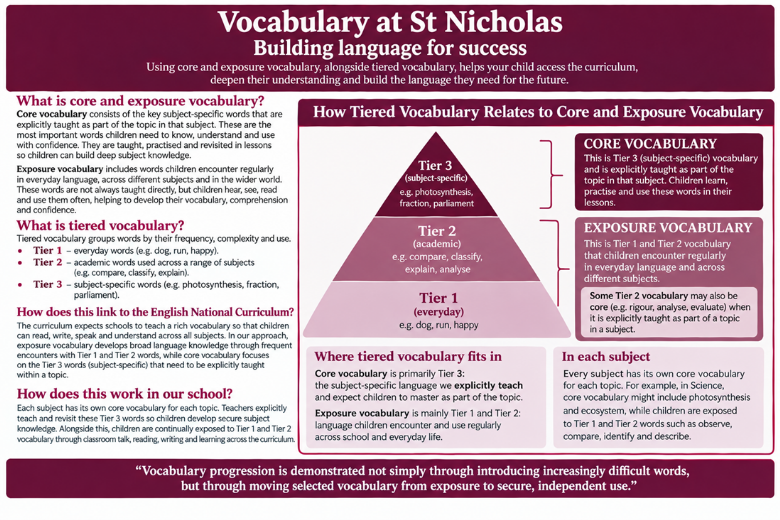
Vocabulary
Assessment
At St Nicholas, assessment in Computing is an ongoing process that enables teachers to monitor pupils' progress, identify gaps in understanding and ensure that all children are supported and challenged appropriately.
We use the Kapow Primary Computing scheme, which provides clear learning objectives and assessment opportunities throughout each unit. At the beginning of every unit, pupils complete a pre-assessment to establish their existing knowledge and understanding. This helps teachers identify prior learning and adapt their teaching to meet the needs of all pupils.
At the end of each unit, pupils complete the same assessment, allowing teachers to measure progress and identify the knowledge and skills they have developed.
Formative assessment takes place throughout lessons through teacher observations, questioning, discussions and practical computing activities. Teachers use assessment checklists linked to the key knowledge and skills for each unit to track individual pupils' progress and identify when children can confidently demonstrate their learning.
Evidence of learning is collected through saved digital work, photographs of practical activities and assessment records. This provides a clear picture of pupils' achievements and progression over time.
Assessment information is used to inform future planning, provide additional support where needed and offer further challenges to deepen understanding. Through this approach, we ensure that all pupils make progress in Computing, developing the confidence, knowledge and practical skills needed to become capable and responsible users of technology.
Enrichment and Cultural Capital
At St Nicholas, we believe Computing inspires curiosity, creativity and problem-solving while preparing children for an increasingly digital world. Through engaging experiences, including virtual reality, programming and digital design, children develop the confidence and skills to explore technology safely, creatively and purposefully. We aim to inspire the next generation of digital thinkers, creators and innovators. We do this through:
Reading across the Curriculum
Accordion content
Pupil Voice
We value our pupils' views and experiences of Computing and E-Safety. Their feedback shows that children particularly enjoy exploring new technologies, developing their digital skills and using technology creatively. Pupils demonstrate an increasing understanding of how to stay safe online, recognise potential risks and make responsible choices when using digital devices.
“I learnt how to give instructions to a Bee-Bot to make it move in different directions.” – Year 1 pupil
“I enjoy coding because you have to put the instructions in the right order to make things happen.” – Year 2 pupil
“I like using Scratch because we can create our own characters and make them move. If something doesn't work, we can find the mistake and fix it.” – Year 3 pupil
“I enjoy Computing because we get to be creative and use different programmes to make things. I like learning new skills that I can use at home too.” – Year 4 pupil
“We used virtual reality headsets to explore different places. It felt like we were actually there, and it helped us understand what we were learning about.” – Year 5 pupil
“I know that our digital footprint is the information we leave behind when we use the internet. We need to think carefully before posting things online.” – Year 5 pupil
“E-Safety is important because we use technology every day. We have learnt how to recognise online risks, protect our personal information and report anything that makes us feel uncomfortable.” – Year 6 pupil