St. NicholasCatholic Primary School




‘Love one another, as I have loved you’
Design & Technology
Our Curriculum Intent
At St Nicholas we are committed to providing a curriculum for all where every child grows:
- Academically
- Socially
- Morally
- In aspiration
- To be prepared for the next phase in their academic journey and be spiritually nourished.
To achieve excellence in all that they do in the knowledge that we love one another as God loves you.
We are committed to being a fully inclusive school, where all pupils are welcomed, valued and supported to succeed. We provide a broad and balanced curriculum for all pupils, underpinned by high expectations and a belief that every child can achieve.
Our first approach is always high-quality teaching, where the learning objective remains the same for all pupils. We do not routinely lower expectations. Instead, we focus on identifying and removing barriers to learning, adapting how pupils access the curriculum. For pupils working significantly below age-related expectations, learning is adapted so that they remain fully included in the same curriculum experiences, themes and contexts as their peers, while working towards personalised targets linked to their individual needs. Support is planned and reviewed through the school’s graduated approach of assess, plan, do, review, ensuring that provision is responsive, builds over time, and leads to meaningful progress and increasing independence.
Meet the Subject Leader
"Hello, we are Miss Newland and Mrs Littlewood, the Design & Technology Subject Leaders at St Nicholas Catholic Primary School.
Design & Technology is a creative and practical subject that encourages children to think, design, make and solve problems. At St Nicholas, we want children to see themselves as designers, makers and problem-solvers who can use their creativity and practical skills to develop solutions to real-life needs.
Through Design & Technology, children learn how products are designed and made and develop an understanding of how materials, tools, mechanisms, electrical systems, food and technology can be used to create purposeful products.
We encourage children to make their own design decisions, work collaboratively, develop practical skills and evaluate their finished products. We want our children to recognise that Design & Technology is part of everyday life and to understand how designers and engineers can use creativity and innovation to make a positive difference to the world around us".
Inclusion
At St Nicholas, we are committed to being a fully inclusive school, where all pupils are welcomed, valued and supported to succeed. We provide a broad and balanced curriculum for all pupils, underpinned by high expectations and a belief that every child can achieve.
Our first approach is always high-quality teaching, where the learning objective remains the same for all pupils. We do not routinely lower expectations.
Instead, we focus on identifying and removing barriers to learning, adapting how pupils access the curriculum through:
- breaking the design and making process into manageable steps
- step-by-step instructions and visual checklists
- templates, patterns and examples
- clear demonstrations of practical techniques
- diagrams, photographs and labelled examples
- pre-teaching and reinforcement of technical vocabulary
- word mats and visual prompts
- opportunities to discuss and explain design decisions
- real materials, products and practical experiences
- adult prompting and questioning
- appropriate grouping and collaborative practical work
Where needed, pupils may demonstrate their understanding in different ways, including:
- verbal explanations
- practical demonstrations
- annotated drawings and diagrams
- models and prototypes
- photographs of practical outcomes
- supported or adapted recording
For pupils working significantly below age-related expectations, learning is adapted so that they remain fully included in the same curriculum experiences, themes and contexts as their peers, while working towards personalised targets linked to their individual needs.
Support is planned and reviewed through the school's graduated approach of assess, plan, do, review, ensuring that provision is responsive, builds over time, and leads to meaningful progress and increasing independence.
EYFS Foundations
In Reception, the foundations of Design & Technology are developed through the Expressive Arts and Design and Physical Development areas of the EYFS curriculum.
Children are given opportunities to explore and investigate different materials, tools and joining techniques through practical, play-based experiences. They develop their fine motor skills while cutting, joining, threading, building, shaping and manipulating materials.
Children begin to make simple choices about the materials they use and develop an understanding that different materials have different properties and purposes.
Kapow's Reception Design & Technology curriculum includes opportunities to explore structures, cooking and nutrition, textiles and materials. For example, children investigate materials through junk modelling, develop threading and sewing skills when making bookmarks, explore food through soup-making and investigate waterproof materials when designing and making boats.
Children are encouraged to talk about what they are making, explain their choices and solve problems as they work. Adults model appropriate vocabulary and ask questions such as:
- What are you making?
- What materials could you use?
- Why have you chosen that material?
- How could you join these together?
- What could you change to make it better?
These experiences develop children's creativity, problem-solving, fine motor skills and independence, preparing them for the more structured Design & Technology curriculum in Year 1.
Progression in Design & Technology
Our curriculum is carefully sequenced so that pupils build knowledge and develop skills progressively over time. We use KAPOW to support curriculum design, drawing carefully on its progression of knowledge and skills to ensure learning builds securely from pupils’ starting points towards increasingly complex concepts and outcomes.
The scheme is not used as an off-the-shelf curriculum. Leaders and teachers carefully select, adapt and supplement its content to meet the requirements of the National Curriculum and the needs of our pupils. This includes adding our own learning where appropriate and considering pupils’ backgrounds, cultures, experiences and local context, ensuring that the curriculum is relevant, representative and ambitious for the children at St Nicholas.
Progression mapping is carefully applied across our mixed-age classes, ensuring pupils access their age-appropriate curriculum entitlement while making meaningful connections with learning across the class. Teachers use progression documents to identify what pupils should know, understand and be able to do, building deliberately on prior learning, avoiding unnecessary repetition and preparing pupils for what comes next.
This ensures that, while KAPOW provides a strong structure and progression framework, the curriculum pupils experience is distinctly our own: carefully designed, inclusive and responsive to the St Nicholas community.
Design & Technology National Curriculum
At our primary school, we are committed to providing a broad, balanced and ambitious Design and Technology curriculum that fully meets the requirements of the National Curriculum. Our curriculum is carefully sequenced to ensure that pupils progressively develop their knowledge, skills and understanding as they move through the school.
Our teaching provides comprehensive coverage of the statutory programmes of study for Design and Technology, including designing, making, evaluating and developing technical knowledge. Pupils are explicitly taught how to select and use a range of materials, tools and techniques safely and effectively, while developing their understanding of structures, mechanisms, electrical systems, cooking and nutrition.
Pupils are given frequent opportunities to apply their knowledge and skills through purposeful, creative and practical projects. They are encouraged to identify needs and opportunities, develop their own ideas, communicate designs and create functional products for specific purposes and users. Through practical experiences, pupils learn to solve problems, make informed choices, test ideas and refine their designs.
The progression of knowledge and skills across each year group ensures that pupils revisit, develop and embed key concepts, techniques and subject-specific vocabulary. Pupils build increasing confidence in using tools and materials, understanding how products work and applying technical knowledge to their own designs. Assessment is used to identify pupils’ strengths and areas for development, enabling teachers to adapt teaching and provide appropriate support and challenge.
Through our Design and Technology curriculum, we aim to ensure that every pupil leaves primary school with a secure foundation of practical skills, technical knowledge and creative problem-solving abilities. We aim to develop pupils who are curious, resourceful and resilient, with the confidence to design, make, evaluate and improve products while understanding the impact of design and technology on individuals, society and the wider world.
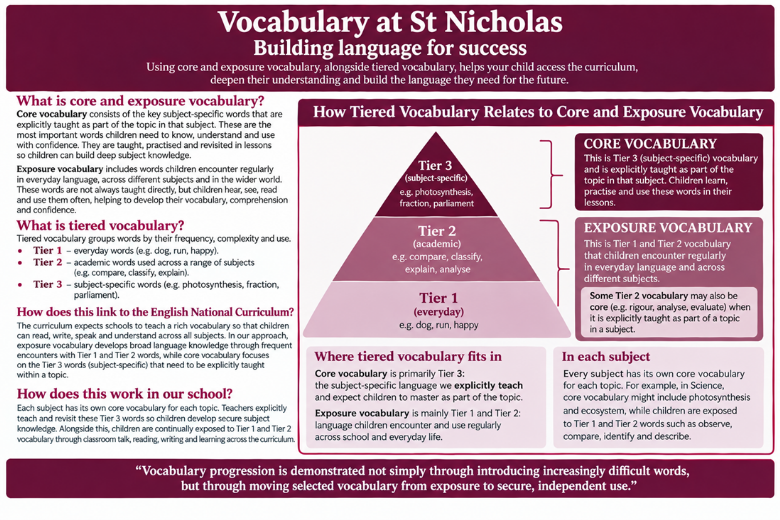
Vocabulary
Assessment
In Design & Technology, assessment is used to help teachers understand what children know, understand and can do.
Teachers assess learning throughout each unit through questioning, discussion, observation and practical activities. This allows teachers to identify children's understanding and provide appropriate support or challenge.
Children's practical work, designs, prototypes and evaluations provide further evidence of their learning. Teachers assess how effectively pupils apply their knowledge and skills when designing, making and evaluating products.
Assessment information is used to identify gaps, revisit important knowledge and support progression into future units.
Enrichment and Cultural Capital
Design & Technology provides children with opportunities to connect their classroom learning to the real world and future careers.
Across the school, children have opportunities to:
- explore the work of designers, engineers and innovators
- investigate how everyday products are designed and made
- work with a range of materials, tools and technologies
- develop practical problem-solving skills
- make connections between Design & Technology and other curriculum subjects
- consider the environmental impact of materials, products and food
- understand how design and technology can be used to improve people's lives
Where appropriate, Design & Technology projects are linked to real-life contexts and current issues, giving children's learning a clear purpose.
Reading across the Curriculum
Reading is an important part of Design & Technology. Children encounter technical vocabulary, instructions, information texts and examples of designers and products throughout their learning.
Reading opportunities support children to:
- develop subject-specific vocabulary
- understand how products and systems work
- research materials, designers and existing products
- follow instructions and processes
- investigate real-world design problems
- communicate and evaluate their ideas
- Suggested texts
Suggested reading:
EYFS
Rosie's Walk – Pat Hutchins
The Most Magnificent Thing – Ashley Spires
Junkyard – Mike Austin
The Little Red Hen – traditional tale
Year 1
The Most Magnificent Thing – Ashley Spires
Izzy Gizmo – Pip Jones
George and the Dragon – Chris Wormell
The Three Little Pigs – traditional tale
Year 2
The Three Little Wolves and the Big Bad Pig – Eugene Trivizas
The Most Magnificent Thing – Ashley Spires
Rosie Revere, Engineer – Andrea Beaty
Ada Twist, Scientist – Andrea Beaty
Year 3
The Iron Man – Ted Hughes
Rosie Revere, Engineer – Andrea Beaty
The Inventor – John W. Rocconi
Look Inside Engineering – Usborne
Year 4
The Inventor – John W. Rocconi
The Iron Man – Ted Hughes
Ada Twist, Scientist – Andrea Beaty
The Way Things Work Now – David Macaulay
Year 5
The Most Magnificent Thing – Ashley Spires
The Boy Who Harnessed the Wind – William Kamkwamba and Bryan Mealer
Rosie Revere, Engineer – Andrea Beaty
The Way Things Work Now – David Macaulay
Year 6
The Boy Who Harnessed the Wind – William Kamkwamba and Bryan Mealer
The Invention of Hugo Cabret – Brian Selznick
The Way Things Work Now – David Macaulay
The Story of Inventions – Anna Claybourne
Pupil Voice
We value our pupils' views and experiences of Design & Technology. Their feedback shows that children particularly enjoy the creative and practical nature of the subject, as well as the opportunity to work collaboratively and see their ideas become real products.
- “I like building and using my imagination.” - Year 1 pupil
- “I like that you can do what you want and there are no rules.” - Year 3 pupil
- “I am trying to get better at making things structurally sound and measuring precisely.” - Year 6 pupil
- “I have got better at planning, imagining and building.” - Year 4 pupil
Children also identified teamwork, planning and precision as important skills and expressed an interest in having more opportunities to explore structures, painting and live sketching.