St. NicholasCatholic Primary School



‘Love one another, as I have loved you’
Art & Design
Our Curriculum Intent
At St Nicholas we are committed to providing a curriculum for all where every child grows:
- Academically
- Socially
- Morally
- In aspiration
- To be prepared for the next phase in their academic journey and be spiritually nourished.
To achieve excellence in all that they do in the knowledge that we love one another as God loves you.
We are committed to being a fully inclusive school, where all pupils are welcomed, valued and supported to succeed. We provide a broad and balanced curriculum for all pupils, underpinned by high expectations and a belief that every child can achieve.
Our first approach is always high-quality teaching, where the learning objective remains the same for all pupils. We do not routinely lower expectations. Instead, we focus on identifying and removing barriers to learning, adapting how pupils access the curriculum. For pupils working significantly below age-related expectations, learning is adapted so that they remain fully included in the same curriculum experiences, themes and contexts as their peers, while working towards personalised targets linked to their individual needs. Support is planned and reviewed through the school’s graduated approach of assess, plan, do, review, ensuring that provision is responsive, builds over time, and leads to meaningful progress and increasing independence.
Meet the Subject Leader
"Hello we are Miss Newland and Mrs Littlewood, the Art & Design Subject Leaders at St Nicholas Catholic Primary School.
Art & Design is an important part of our curriculum because it gives children opportunities to express themselves, develop their creativity and communicate ideas in different ways. At St Nicholas, we want children to see themselves as artists, designers and creative thinkers who can explore ideas, experiment with materials and develop their own artistic identity.
Through Art & Design, children develop knowledge and skills across drawing, painting and mixed media, sculpture and 3D, and craft and design. They learn about a diverse range of artists, craftspeople, designers, cultures and traditions, helping them to understand and appreciate the many different ways art can be created and experienced.
We encourage children to experiment, practise, refine and make creative decisions. We want children to develop confidence in their own ideas, reflect on their work and understand that art is a way of communicating, exploring and making sense of the world around them."
Inclusion
At St Nicholas, we are committed to being a fully inclusive school, where all pupils are welcomed, valued and supported to succeed. We provide a broad and balanced curriculum for all pupils, underpinned by high expectations and a belief that every child can achieve.
Our first approach is always high-quality teaching, where the learning objective remains the same for all pupils. We do not routinely lower expectations.
Instead, we focus on identifying and removing barriers to learning, adapting how pupils access the curriculum through:
- carefully planned scaffolding
- explicit modelling of artistic skills and techniques
- visual examples and demonstrations
- pre-teaching and reinforcement of vocabulary
- structured opportunities for talk and discussion
- practical and concrete resources
- flexible grouping and adult support
- opportunities to explore and practise skills before creating final outcomes
Where needed, pupils may demonstrate their understanding in different ways, including:
- verbal responses
- practical demonstrations
- artwork, drawings, paintings, models and creative outcomes
- annotated drawings and photographs
- supported recording
- assistive technology
For pupils working significantly below age-related expectations, learning is adapted so that they remain fully included in the same curriculum experiences, themes and contexts as their peers, while working towards personalised targets linked to their individual needs.
Support is planned and reviewed through the school's graduated approach of assess, plan, do, review, ensuring that provision is responsive, builds over time, and leads to meaningful progress and increasing independence.
All teachers are responsible for the progress and inclusion of all pupils in their class, and support staff are deployed to enhance access and promote independence, rather than replace teacher interaction.
EYFS Foundations
In Reception, the foundations of Art & Design are developed through the Expressive Arts and Design and Physical Development areas of the EYFS curriculum.
Children are given opportunities to explore and experiment with a wide range of materials, tools, colours, textures and techniques through practical, play-based experiences. They develop their fine motor skills while drawing, painting, cutting, joining, modelling and manipulating materials.
Children begin to make choices about the materials and techniques they use and are encouraged to express their ideas and respond creatively to their experiences.
Kapow's Reception Art & Design curriculum provides opportunities for children to explore colour, painting, drawing, sculpture, collage and different materials.
Children are encouraged to talk about their artwork, explain their choices and respond to the work of others. Adults model appropriate vocabulary and ask questions such as:
- What have you made?
- What materials have you used?
- Why did you choose that colour?
- How did you make it?
- What could you change or add?
- How does your artwork make you feel?
These experiences develop children's creativity, fine motor skills, confidence and independence, preparing them for the more structured Art & Design curriculum in Year 1.
Progression in Art & Design
Our curriculum is carefully sequenced so that pupils build knowledge and develop skills progressively over time. We use KAPOW to support curriculum design, drawing carefully on its progression of knowledge and skills to ensure learning builds securely from pupils’ starting points towards increasingly complex concepts and outcomes.
The scheme is not used as an off-the-shelf curriculum. Leaders and teachers carefully select, adapt and supplement its content to meet the requirements of the National Curriculum and the needs of our pupils. This includes adding our own learning where appropriate and considering pupils’ backgrounds, cultures, experiences and local context, ensuring that the curriculum is relevant, representative and ambitious for the children at St Nicholas.
Progression mapping is carefully applied across our mixed-age classes, ensuring pupils access their age-appropriate curriculum entitlement while making meaningful connections with learning across the class. Teachers use progression documents to identify what pupils should know, understand and be able to do, building deliberately on prior learning, avoiding unnecessary repetition and preparing pupils for what comes next.
This ensures that, while KAPOW provides a strong structure and progression framework, the curriculum pupils experience is distinctly our own: carefully designed, inclusive and responsive to the St Nicholas community.
Art & Design National Curriculum
At our primary school, we are committed to providing a broad, balanced and ambitious Art and Design curriculum that fully meets the requirements of the National Curriculum. Our curriculum is carefully sequenced to ensure that pupils progressively develop their knowledge, skills and understanding as they move through the school.
Our teaching provides comprehensive coverage of the statutory programmes of study for Art and Design, including drawing, painting, sculpture and other art, craft and design techniques. Pupils are explicitly taught how to use a range of materials, tools and techniques, while developing their ability to explore, experiment, refine and communicate their own creative ideas.
Pupils are given frequent opportunities to work creatively and apply their artistic skills in meaningful contexts. Through studying a diverse range of artists, craftspeople, designers and artistic traditions, pupils develop an understanding of how art and design can communicate ideas, emotions, experiences and perspectives. They are encouraged to observe carefully, develop their own ideas, take creative risks and respond thoughtfully to their own work and the work of others.
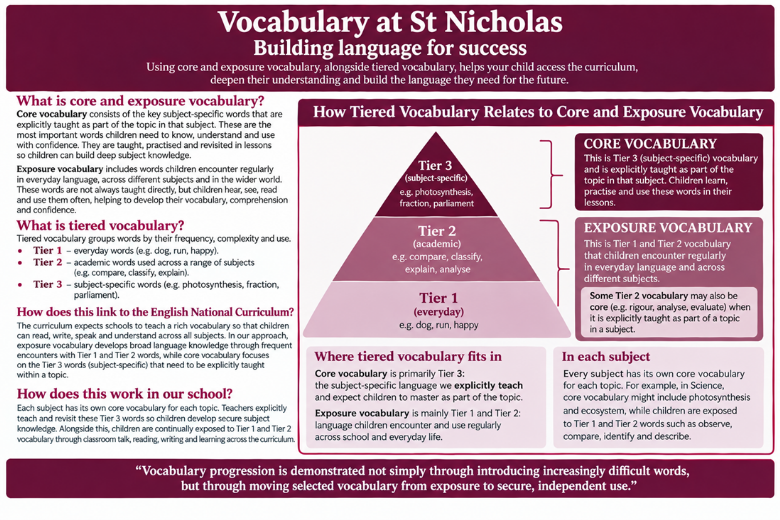
The progression of knowledge and skills across each year group ensures that pupils revisit, develop and embed key artistic concepts, techniques and vocabulary. Assessment is used to identify pupils’ strengths and areas for development, enabling teachers to adapt teaching and provide appropriate support and challenge.
Vocabulary
Assessment
In Art & Design, assessment is used to help teachers understand what children know, understand and can do.
Teachers assess learning throughout each unit through questioning, discussion, observation, practical activities and quizzes. This allows teachers to identify children's understanding and provide appropriate support or challenge.
Children's sketchbooks and artwork provide evidence of their learning and development. Teachers assess how effectively pupils apply their knowledge, skills and techniques when experimenting, creating and evaluating artwork.
Assessment information is used to identify strengths, misconceptions and next steps, as well as opportunities to revisit and develop important knowledge and skills.
Enrichment and Cultural Capital
Art & Design provides children with opportunities to explore different cultures, artistic traditions and creative practices.
Across the school, children have opportunities to:
- explore the work of a diverse range of artists, craftspeople and designers
- investigate different artistic styles, cultures and traditions
- work with a range of materials, tools and techniques
- develop creative thinking and problem-solving skills
- make connections between Art & Design and other curriculum subjects
- develop their own creative ideas and artistic identity
- reflect on and appreciate the artwork of others
- celebrate and share their own artwork through displays around school
Reading across the Curriculum
Reading is an important part of Art & Design. Children encounter artistic vocabulary, information about artists and designers, visual information and examples of artwork throughout their learning.
Reading opportunities support children to:
- develop subject-specific vocabulary
- learn about artists, craftspeople and designers
- explore different cultures, traditions and artistic practices
- understand how artists use materials, techniques and processes
- respond to and discuss artwork
- communicate and evaluate their ideas
- develop their understanding of art through books and visual resources
Suggested Reading
EYFS
- Rosie's Walk – Pat Hutchins
- The Most Magnificent Thing – Ashley Spires
- The Dot – Peter H. Reynolds
- Beautiful Oops! – Barney Saltzberg
Year 1
- The Dot – Peter H. Reynolds
- Ish – Peter H. Reynolds
- The Most Magnificent Thing – Ashley Spires
- Katie and the Sunflowers – James Mayhew
Year 2
- Katie and the Sunflowers – James Mayhew
- The Day the Crayons Quit – Drew Daywalt
- The Most Magnificent Thing – Ashley Spires
- The Shape of My Heart – Mark Sperring
Year 3
- The Boy Who Painted the World – Tom McLaughlin
- The Art Book for Children – Phaidon
- The Iron Man – Ted Hughes
- The Dot – Peter H. Reynolds
Year 4
- The Art Book for Children – Phaidon
- Katie and the Mona Lisa – James Mayhew
- The Boy Who Painted the World – Tom McLaughlin
- Leonardo's Horse – Jean Fritz
Year 5
- The Art Book for Children – Phaidon
- The Fantastic Jungles of Henri Rousseau – Michelle Markel
- Katie and the Impressionists – James Mayhew
- The Boy Who Painted the World – Tom McLaughlin
Year 6
- The Art Book for Children – Phaidon
- The Usborne Book of Art
- Katie and the Impressionists – James Mayhew
- The Fantastic Jungles of Henri Rousseau – Michelle Markel
Pupil Voice
We value our pupils' views and experiences of Art & Design. Their feedback shows that children particularly enjoy the opportunity to be creative, experiment with different materials and techniques, and develop their own ideas.
Children value having opportunities to:
- experiment with different materials
- develop and improve their artistic skills
- make independent creative choices
- learn about different artists and cultures
- express themselves through artwork
- see their work displayed and celebrated
Pupils have also identified opportunities to explore different artistic techniques, develop their skills further and have greater opportunities to create and experiment independently.