St. NicholasCatholic Primary School



History
Our Curriculum Intent
At St Nicholas we are committed to providing a curriculum for all where every child grows:
- Academically
- Socially
- Morally
- In aspiration
- To be prepared for the next phase in their academic journey and be spiritually nourished.
To achieve excellence in all that they do in the knowledge that we love one another as God loves you.
We are committed to being a fully inclusive school, where all pupils are welcomed, valued and supported to succeed. We provide a broad and balanced curriculum for all pupils, underpinned by high expectations and a belief that every child can achieve.
Our first approach is always high-quality teaching, where the learning objective remains the same for all pupils. We do not routinely lower expectations. Instead, we focus on identifying and removing barriers to learning, adapting how pupils access the curriculum. For pupils working significantly below age-related expectations, learning is adapted so that they remain fully included in the same curriculum experiences, themes and contexts as their peers, while working towards personalised targets linked to their individual needs. Support is planned and reviewed through the school’s graduated approach of assess, plan, do, review, ensuring that provision is responsive, builds over time, and leads to meaningful progress and increasing independence.
Meet the Subject Leader
Hello, I am Mrs Smith-Cottle, the History Subject Leader at St Nicholas Catholic Primary School.
At our school, History is taught through the Kapow scheme, which supports children in developing a strong understanding of the past through engaging, enquiry-based learning. We are passionate about helping children become curious historians who ask thoughtful questions, explore evidence and understand how people, places and events have shaped the world we live in today. Through carefully sequenced lessons, children build their historical knowledge, vocabulary and skills over time, allowing them to make meaningful links between different periods of history.
Inclusion
At St Nicholas, we are committed to being a fully inclusive school, where all pupils are welcomed, valued and supported to succeed. We provide a broad and balanced curriculum for all pupils, underpinned by high expectations and a belief that every child can achieve.
Our first approach is always high-quality teaching, where the learning objective remains the same for all pupils. We do not routinely lower expectations. Instead, we focus on identifying and removing barriers to learning, adapting how pupils access the curriculum through:
- sentence stems and writing frames
- diagrams, images and Widget symbols
- visual prompts to support understanding
- use of word mats
- talk partners and structured discussion
- real-life objects
- adult prompting and questioning
- reduced cognitive load through simplified layout and clear instructions
Where needed, pupils may demonstrate their understanding in different ways, including:
- verbal responses with adult scribe
- practical outcomes e.g., drama
- use of assistive technology
- supported or adapted recording
For pupils working significantly below age-related expectations, learning is adapted so that they remain fully included in the same curriculum experiences, themes and contexts as their peers, while working towards personalised targets linked to their individual needs.
Support is planned and reviewed through the school’s graduated approach of assess, plan, do, review, ensuring that provision is responsive, builds over time, and leads to meaningful progress and increasing independence.
All teachers are responsible for the progress and inclusion of all pupils in their class, and support staff are deployed to enhance access and promote independence, rather than replace teacher interaction.
EYFS Foundations
In Reception, the foundations of History are developed through the Understanding the World area of learning, particularly the strand Past and Present. Children begin to explore history by talking about their own lives, their families, people who are important to them and familiar events that have happened over time. Through stories, photographs, role play, celebrations, family discussions and books, children are encouraged to notice similarities and differences between the past and now. This helps them to develop early historical vocabulary such as past, present, now, then, before, after, old and new.
This prepares children for Year 1 History by helping them understand that things change over time and that we can find out about the past in different ways. Children begin to ask and answer simple questions, talk about people and events, sequence familiar experiences and make links between their own lives and the wider world. These early experiences provide the building blocks for later learning in History, where children will explore significant people, events and changes within living memory and beyond.
Progression in History
Our curriculum is carefully sequenced so that pupils build knowledge and develop skills progressively over time. We use KAPOW to support curriculum design, drawing carefully on its progression of knowledge and skills to ensure learning builds securely from pupils’ starting points towards increasingly complex concepts and outcomes.
The scheme is not used as an off-the-shelf curriculum. Leaders and teachers carefully select, adapt and supplement its content to meet the requirements of the National Curriculum and the needs of our pupils. This includes adding our own learning where appropriate and considering pupils’ backgrounds, cultures, experiences and local context, ensuring that the curriculum is relevant, representative and ambitious for the children at St Nicholas.
Progression mapping is carefully applied across our mixed-age classes, ensuring pupils access their age-appropriate curriculum entitlement while making meaningful connections with learning across the class. Teachers use progression documents to identify what pupils should know, understand and be able to do, building deliberately on prior learning, avoiding unnecessary repetition and preparing pupils for what comes next.
This ensures that, while KAPOW provides a strong structure and progression framework, the curriculum pupils experience is distinctly our own: carefully designed, inclusive and responsive to the St Nicholas community.
History National Curriculum
At St Nicholas, we value History as an engaging and important subject that develops pupils’ curiosity about the past and their understanding of how it has shaped the world today. Our curriculum follows the 2014 National Curriculum and provides pupils with a broad and balanced programme of British, local and world history.
Pupils develop a secure chronological understanding and learn to use historical sources and evidence to ask questions, think critically and explore cause and consequence, change and continuity, similarity and difference, and significance.
We aim to make History accessible and meaningful for all pupils, promoting diversity, inclusion and respect for different cultures and perspectives.
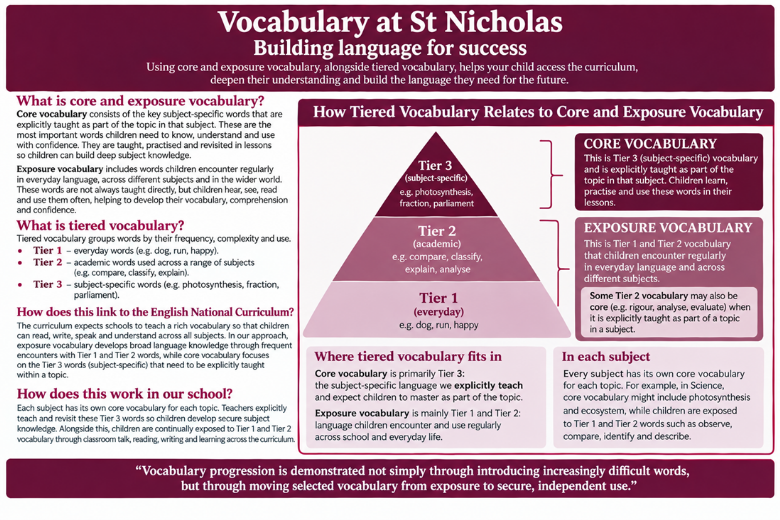
Vocabulary
Assessment
In History, assessment is used to help teachers understand what children already know, what they have remembered and what they need to learn next.
At the beginning of each History unit, children complete a short pre-test to identify their prior knowledge and understanding of the topic. This helps teachers recognise what children already know, spot any misconceptions and adapt planning where needed.
Throughout the unit, teachers assess children’s learning through questioning, discussion, vocabulary use, timelines, source work and the work completed in books. This helps teachers check that children are building their historical knowledge and developing the skills needed to think like historians.
At the end of each unit, children complete a post-test to show what they have learned and remembered. Teachers use this to identify any gaps in learning and to plan opportunities to revisit important knowledge and vocabulary.
This approach helps ensure that children build a secure understanding of the past and can make meaningful links between people, events and periods of history over time.
Enrichment and Cultural Capital
Accordion content
Reading across the Curriculum
Here are high-quality texts and reading opportunities for History from EYFS to Year 6. Included are a mix of:
- Narrative and information texts
- Biographies and historical fiction
- Poetry, picture books and non-fiction
These are useful for subject knowledge, vocabulary development, comparing perspectives and supporting historical enquiry.
EYFS
Peepo! by Janet and Allan Ahlberg
The Three Little Pigs and other traditional tales
Coming to England by Floella Benjamin
The Past by Brian Moses
Then and Now by Heather Amery
All Through the Year by Shirley Hughes
Year 1
The Naughty Bus by Jan and Jerry Oke
Emma Jane’s Aeroplane by Jenny Molloy
Kipper’s Toybox by Mick Inkpen
Florence Nightingale by David A. Adler
The Queen’s Knickers by Nicholas Allan
Old Bear by Jane Hissey
Year 2
The First Drawing by Mordicai Gerstein
The Lighthouse Keeper’s Lunch by Ronda and David Armitage
Street Child by Berlie Doherty
Viking Voyagers by Jack Tite
How To Be a Roman by Dr Roma Agrawal
Nelson Mandela by Maria Isabel Sanchez Vegara
Year 3
Stone Age Boy by Satoshi Kitamura
How to Be an Ancient Greek by Dr Anita Ganeri
Secrets of a Sun King by Emma Carroll
The Egyptian Cinderella by Shirley Climo
The Barefoot Book of Children by Tessa Strickland
The Boy with the Bronze Axe by Kathleen Fidler
Year 4
A Roman Adventure by Frances Durkin
Escape from Pompeii by Christina Balit
Romans on the Rampage by Jeremy Strong
The Adventures of Odysseus by Hugh Lupton
What the Romans Did for Us by Alison Hawes
The Lion, the Witch and the Wardrobe for discussion of historical context and allegory, where appropriate
Year 5
The Viewer by Shaun Tan and Gary Crew
The Arrival by Shaun Tan
You Wouldn’t Want to Be in the American Civil War by Thomas Ratliff
Nelson by Rob Lloyd Jones
The Windrush Child by Benjamin Zephaniah
The Railway Children by E. Nesbit
Year 6
Goodnight Mister Tom by Michelle Magorian
Rose Blanche by Roberto Innocenti
The Boy in the Striped Pyjamas by John Boyne, with careful professional judgement due to sensitive content
When the Sky Falls by Phil Earle
The Promise by Nicola Davies
Freedom Walkers by Russell Freedman
Pupil Voice
Accordion content