St. NicholasCatholic Primary School


Science
Our Curriculum Intent
At St Nicholas we are committed to providing a curriculum for all where every child grows:
- Academically
- Socially
- Morally
- In aspiration
- To be prepared for the next phase in their academic journey and be spiritually nourished.
To achieve excellence in all that they do in the knowledge that we love one another as God loves you.
We are committed to being a fully inclusive school, where all pupils are welcomed, valued and supported to succeed. We provide a broad and balanced curriculum for all pupils, underpinned by high expectations and a belief that every child can achieve.
Our first approach is always high-quality teaching, where the learning objective remains the same for all pupils. We do not routinely lower expectations. Instead, we focus on identifying and removing barriers to learning, adapting how pupils access the curriculum. For pupils working significantly below age-related expectations, learning is adapted so that they remain fully included in the same curriculum experiences, themes and contexts as their peers, while working towards personalised targets linked to their individual needs. Support is planned and reviewed through the school’s graduated approach of assess, plan, do, review, ensuring that provision is responsive, builds over time, and leads to meaningful progress and increasing independence.
Meet the Subject Leader
"Hello, I am Miss Chatt, the Science Subject Leader at St Nicholas Catholic Primary School.
Science is an exciting subject that encourages children to be curious, ask questions and explore the world around them. At our school, we aim to develop enthusiastic young scientists who enjoy investigating, observing, predicting and discovering how things work.
Through practical investigations and engaging lessons, children develop their scientific knowledge and learn how to work scientifically. We encourage pupils to share their ideas, investigate their own questions and understand how science connects to their everyday lives and the wider world.
Inclusion
At St Nicholas, we are committed to being a fully inclusive school, where all pupils are welcomed, valued and supported to succeed. We provide a broad and balanced curriculum for all pupils, underpinned by high expectations and a belief that every child can achieve.
Our first approach is always high-quality teaching, where the learning objective remains the same for all pupils. We do not routinely lower expectations. Instead, we focus on identifying and removing barriers to learning, adapting how pupils access the curriculum through:
- sentence stems and writing frames
- step-by-step models
- diagrams, images and Widget symbols
- visual prompts to support understanding
- use of word mats
- talk partners and structured discussion
- real-life objects and hands-on experiences
- practical demonstrations to support understanding
- adult prompting and questioning
- reduced cognitive load through simplified layout and clear instructions
Where needed, pupils may demonstrate their understanding in different ways, including:
- verbal responses with adult scribe
- practical outcomes
- use of assistive technology
- supported or adapted recording
For pupils working significantly below age-related expectations, learning is adapted so that they remain fully included in the same curriculum experiences, themes and contexts as their peers, while working towards personalised targets linked to their individual needs.
Support is planned and reviewed through the school’s graduated approach of assess, plan, do, review, ensuring that provision is responsive, builds over time, and leads to meaningful progress and increasing independence.
All teachers are responsible for the progress and inclusion of all pupils in their class, and support staff are deployed to enhance access and promote independence, rather than replace teacher interaction.
EYFS Foundations
In Reception, the foundations of Science are developed mainly through the EYFS area of Understanding the World. Children are encouraged to explore, investigate and make sense of the world around them through carefully planned, play-based learning experiences.
The Curiosity Cube is used to capture children’s interest and encourage them to ask questions. Objects, photographs or clues linked to a new topic are placed inside the cube for children to observe and discuss. Children are encouraged to share what they notice, what they think and what they would like to find out. This helps to develop their confidence, curiosity and early scientific questioning skills.
Children take part in practical activities that allow them to explore materials, observe seasonal changes and learn about plants, animals and the natural environment. Real-life experiences, such as watching chicks and ducklings hatch, give children meaningful opportunities to observe growth and change over time. They learn how to care for living things and begin to understand what animals need to survive.
Forest School provides further opportunities for children to learn through first-hand experiences in the natural environment. Children observe plants, trees, insects and wildlife, notice changes across the seasons and explore natural materials. These experiences help them to develop careful observation skills, confidence, independence and respect for the world around them.
Adults model scientific vocabulary and use questions such as “What do you notice?”, “What has changed?”, “What do you think will happen next?” and “Why do you think that?” Children are encouraged to look closely, compare, sort, make simple predictions and talk about their findings.
These play-based, practical and outdoor learning experiences prepare children for Year 1 by developing their understanding of the world and introducing the early skills needed for working scientifically. Children move into Key Stage 1 with experience of observing closely, asking questions, noticing changes, comparing objects and living things, and sharing their ideas.
Progression in Science
Our curriculum is carefully sequenced so that pupils build knowledge and develop skills progressively over time. We use KAPOW to support curriculum design, drawing carefully on its progression of knowledge and skills to ensure learning builds securely from pupils’ starting points towards increasingly complex concepts and outcomes.
The scheme is not used as an off-the-shelf curriculum. Leaders and teachers carefully select, adapt and supplement its content to meet the requirements of the National Curriculum and the needs of our pupils. This includes adding our own learning where appropriate and considering pupils’ backgrounds, cultures, experiences and local context, ensuring that the curriculum is relevant, representative and ambitious for the children at St Nicholas.
Progression mapping is carefully applied across our mixed-age classes, ensuring pupils access their age-appropriate curriculum entitlement while making meaningful connections with learning across the class. Teachers use progression documents to identify what pupils should know, understand and be able to do, building deliberately on prior learning, avoiding unnecessary repetition and preparing pupils for what comes next.
This ensures that, while KAPOW provides a strong structure and progression framework, the curriculum pupils experience is distinctly our own: carefully designed, inclusive and responsive to the St Nicholas community.
Science National Curriculum
At St Nicholas, Science is taught in line with the National Curriculum, providing pupils with opportunities to develop their knowledge and understanding of the world around them. Pupils explore a broad range of scientific concepts through practical investigation, observation and enquiry.
Through Science, pupils develop important skills including asking questions, making predictions, carrying out investigations, recording and analysing results, and drawing conclusions. We aim to inspire curiosity and encourage pupils to think scientifically, develop their understanding of the world, and recognise the importance of Science in everyday life.
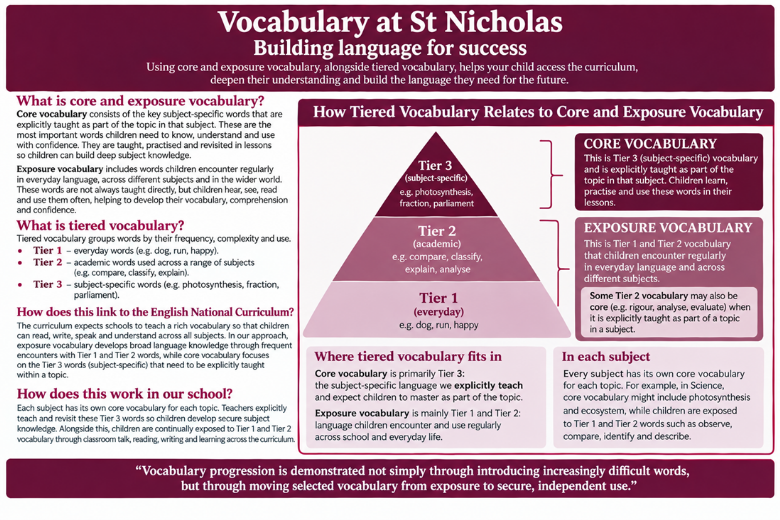
Vocabulary
Assessment
In Science, assessment is used to help teachers understand what children already know, what they have remembered and what they need to learn next.
At the beginning of each unit, children complete a short pre-assessment to identify their prior knowledge and any existing understanding of the topic. This may include activities such as mind maps, drawing and labelling, true or false statements, retrieval questions or a short quiz. Teachers use this information to adapt planning so that lessons build on what children already know and address any gaps or misconceptions.
Throughout each unit, teachers assess children’s learning through questioning, discussion, practical investigations, observations and work in books. This helps teachers check understanding during lessons and provide support or challenge where needed.
At the end of each unit, children complete a Kapow end-of-unit assessment to show what they have learned. Teachers use these outcomes to identify any areas that may need revisiting and to support future planning. More formal assessments are also completed at key points to ensure children are secure in the required National Curriculum knowledge and skills.
This approach helps us make sure that children are not just completing Science lessons, but are remembering key knowledge, developing scientific enquiry skills and building confidence as young scientists.
Enrichment and Cultural Capital
At St Nicholas, we believe that enrichment and the development of cultural capital are essential in providing pupils with experiences that extend beyond the classroom. We aim to give every child opportunities to develop their knowledge, curiosity, confidence and understanding of the wider world.
Science plays an important role in this by encouraging pupils to ask questions, explore, investigate and make sense of the world around them. Through practical experiences, visitors, trips and links to real-life scientific developments, pupils are able to apply their learning in meaningful contexts. These experiences help children develop an appreciation of how science influences our lives and the wider world, while inspiring curiosity and ambition for the future.
We value enrichment as a way of ensuring that all pupils, regardless of background, have access to experiences that broaden their horizons and build the knowledge, skills and confidence they need to thrive. We do this through:
- British Science Week
- St Nicholas Science Fair
- Forest Schools
- Pro-ride linked with PE based on bodies and health
- Real-life chicks and ducks
- Cooking links with DT based on health and nutrition
- Little Life Savers linked with PSHE based on first aid
- Latheron Hall Trip
- Skelton Grange Trip
Reading across the Curriculum
Here are high-quality texts and reading opportunities for Science from EYFS to Year 6. Included are a mix of:
- Story and information texts
- Poetry and non-fiction
- Books that support enquiry, vocabulary and scientific thinking
These texts can be used as subject links, class reading displays, book corners, guided reading texts, or stimulus texts for investigations and writing.
EYFS
The Tiny Seed by Eric Carle
The Very Hungry Caterpillar by Eric Carle
Elmer by David McKee
The Growing Story by Ruth Krauss
Handa’s Surprise by Eileen Browne
The Rainbow Fish by Marcus Pfister
What the Ladybird Heard by Julia Donaldson
Aaaarrgghh, Spider! by Lydia Monks
Year 1
Tadpole’s Promise by Jeanne Willis and Tony Ross
Jack and the Beanstalk retellings linked to plants and growth
Once There Were Giants by Martin Waddell
Avocado Baby by John Burningham
Funnybones by Janet and Allan Ahlberg
George and the Dragon by Chris Wormell for discussion of materials and forces in stories
First Big Book of Why by Sally Symes
Year 2
The Bog Baby by Jeanne Willis
A Seed is Sleepy by Dianna Hutts Aston
George Saves the World by Lunchtime by Jo Readman
Me… Jane by Patrick McDonnell
The Owl Who Was Afraid of the Dark by Jill Tomlinson
The Way Things Work by David Macaulay
One Day on Our Blue Planet by Ella Bailey
Year 3
Ug: Boy Genius of the Stone Age by Raymond Briggs
How to Be an Explorer of the World by Keri Smith
The Street Beneath My Feet by Charlotte Guillain and Yuval Zommer
The Pebble in My Pocket by Meredith Hooper
The Kingfisher First Human Body Encyclopedia
The Magic School Bus Inside the Earth by Joanna Cole
Year 4
The Big Book of Blooms by Yuval Zommer
The Iron Man by Ted Hughes
Horrible Science: Chemical Chaos by Nick Arnold
Horrible Science: Fatal Forces by Nick Arnold
The Shark Whisperer by Ellen Prager
Because a Fire Was in My Head by Lynne Truss
Year 5
Storm by Sam Usher
The Great Kapok Tree by Lynne Cherry
Horrible Science: Shocking Electricity by Nick Arnold
Planet Earth Is Blue by Nicole Panteleakos
You Wouldn’t Want to Live Without Plastic! by Roger Canavan
The Extraordinary Life of Marie Curie by Fiona Macdonald
Year 6
The Unseen World of Pollen by Louise Brierley
Can We Save the Tiger? by Martin Jenkins
Horrible Science: Deadly Diseases by Nick Arnold
Absolutely Everything! by Christopher Lloyd
The Story of Life: A First Book about Evolution by Catherine Barr
Countdown to Disaster by B. J. Best for cross-curricular STEM reading
Exploring the Deep, Dark Sea by Chloe Savage
Pupil Voice
We value what our children have to say about Science and use their views to help us celebrate what they enjoy and identify ways we can continue to develop our provision. Here is what some of our pupils say about Science at our school:
“I made a circuit with my friends, the light came on. It was electricity.”- Y4 pupil with SEND
“We went outside and found materials like sticks, leaves, small branches, pieces of bark and wood. Then we came inside and made birds nests because we were learning about habitats and birds lay eggs in nests. We needed to keep the eggs warm and cosy.”- Year 1 pupil
“We made a circuit using wires, batteries and a switch. We made out own switches and the light had to come on, if it didn’t come on it was a open switch. We then drew a diagram in our books explaining each part.”- Year 4 pupil
“I am proud of the life cycle I drew, my drawings are really great. A person starts as a baby and ends up being an old adult.”- Year 1 pupil with SEND
“We used a torch light to help us see in the dark because eyes can’t see in the dark, they need help from light.”- Year 3 pupil