St. NicholasCatholic Primary School



Reading
Our Curriculum Intent
At St Nicholas we are committed to providing a curriculum for all where every child grows:
- Academically
- Socially
- Morally
- In aspiration
- To be prepared for the next phase in their academic journey and be spiritually nourished.
To achieve excellence in all that they do in the knowledge that we love one another as God loves you.
We are committed to being a fully inclusive school, where all pupils are welcomed, valued and supported to succeed. We provide a broad and balanced curriculum for all pupils, underpinned by high expectations and a belief that every child can achieve.
Our first approach is always high-quality teaching, where the learning objective remains the same for all pupils. We do not routinely lower expectations. Instead, we focus on identifying and removing barriers to learning, adapting how pupils access the curriculum. For pupils working significantly below age-related expectations, learning is adapted so that they remain fully included in the same curriculum experiences, themes and contexts as their peers, while working towards personalised targets linked to their individual needs. Support is planned and reviewed through the school’s graduated approach of assess, plan, do, review, ensuring that provision is responsive, builds over time, and leads to meaningful progress and increasing independence.
Meet the Subject Leader
"Hello, we are Miss Hayden and Mrs Doherty, the Reading Subject Leaders at St Nicholas Catholic Primary School.
Reading is one of our main priorities at St Nicholas. We believe that reading is fundamental to children’s education and underpins their ability to access the wider curriculum. Through reading, children broaden their vocabulary, develop their imagination, learn about the world around them and develop a lifelong love of literature.
We aim to develop confident, fluent and enthusiastic readers who read widely and often for both pleasure and information. Through high-quality texts, explicit teaching, rich discussion and opportunities to read independently, we support children to develop strong comprehension, fluency and reading habits. Our ultimate aim is for every child to leave St Nicholas able to read fluently, confidently and with enjoyment."
Inclusion
At St Nicholas, we are committed to being a fully inclusive school, where all pupils are welcomed, valued and supported to succeed. We provide a broad and balanced curriculum for all pupils, underpinned by high expectations and a belief that every child can achieve.
Our first approach is always high-quality teaching, where the learning objective remains the same for all pupils. We do not routinely lower expectations. Instead, we focus on identifying and removing barriers to learning, adapting how pupils access the curriculum through:
- carefully planned scaffolding
- explicit modelling and use of visuals
- pre-teaching and reinforcement of key vocabulary
- structured opportunities for talk and communication
- flexible grouping and adult support where appropriate
- teacher think-alouds
- repetition and revisiting key terms
- linking new vocabulary to prior learning
- talk partners and structured discussion
- sentence starters and guided responses
- targeted questioning
Where needed, pupils may demonstrate their understanding in different ways, including:
- verbal responses
- picture/diagram responses
- opinion response
- multiple choice style comprehension questioning
For pupils working significantly below age-related expectations, learning is adapted so that they remain fully included in the same curriculum experiences, themes and contexts as their peers, while working towards personalised targets linked to their individual needs.
Support is planned and reviewed through the school’s graduated approach of assess, plan, do, review, ensuring that provision is responsive, builds over time, and leads to meaningful progress and increasing independence.
All teachers are responsible for the progress and inclusion of all pupils in their class, and support staff are deployed to enhance access and promote independence, rather than replace teacher interaction
EYFS Foundations
Reading begins in Reception, where children develop the early communication, language and literacy skills that provide the foundations for becoming successful readers. Children are immersed in stories, rhymes, songs, poetry and high-quality texts, developing their listening, attention, vocabulary and understanding.
Nursery rhymes, songs and repeated refrains are an important part of children’s early reading experiences. In Reception, children have daily opportunities to develop their awareness of rhyme, rhythm and sounds, including regular repetition and a dedicated session with a pianist. These experiences support children to develop their language, confidence and enjoyment of books and spoken language.
Phonics and early reading are a priority at St Nicholas and are taught daily through Read Write Inc. Children develop their ability to recognise and blend sounds and begin to apply this knowledge when reading books matched to their developing phonics knowledge. Alongside phonics, children listen to and discuss stories, poems and non-fiction, developing comprehension, vocabulary and a love of literature.
By the end of Reception, children are developing the secure foundations needed to access the Year 1 reading curriculum, with teachers using ongoing assessment and observation to identify starting points and build learning progressively.
Progression in Reading
Our Reading curriculum is carefully sequenced so that pupils build knowledge, develop reading skills and increase their confidence progressively over time. We do not follow a single commercial reading scheme. Instead, our curriculum has been designed by the school to reflect the needs of our pupils and the requirements of the National Curriculum.
Progression begins in Reception, where children develop the foundations for reading through high-quality stories, rhymes, songs, vocabulary development and daily Read Write Inc. phonics teaching. As pupils move through the school, they build systematically from phonics and early reading into fluency, comprehension and reading for pleasure.
Our progression ensures that pupils develop increasingly sophisticated reading strategies, including retrieving information, predicting, making inferences, summarising, connecting ideas, discussing vocabulary and considering an author’s choices. Fluency is explicitly developed through repeated, choral and paired reading, while comprehension is strengthened through discussion and close engagement with a wide range of texts.
We use a carefully selected range of fiction, non-fiction and poetry, supported by our Reading Spine, class libraries and curriculum texts. Texts are deliberately chosen to broaden pupils’ vocabulary, knowledge and understanding of the world, while developing a lifelong love of reading. Poetry is also given a dedicated place within our progression, with each class exploring a poem as a fluency text each half term.
Teachers use our progression documents to identify what pupils should know, understand and be able to do at each stage. Learning builds deliberately on prior knowledge and skills, while avoiding unnecessary repetition and ensuring pupils are prepared for the next stage of their reading journey.
Our curriculum is therefore distinctly our own: carefully sequenced, ambitious and inclusive, with progression from early phonics through to fluent, confident and independent reading by the end of Key Stage 2.
Reading National Curriculum
At St Nicholas, we are committed to providing a broad, balanced and ambitious Reading curriculum that meets the requirements of the National Curriculum. The National Curriculum identifies two key dimensions of reading: word reading and comprehension. We recognise the importance of developing both areas alongside one another.
In the early stages, systematic phonics teaching provides children with the skills they need to decode accurately and develop automatic word recognition. As children become increasingly secure in their decoding, teaching places greater emphasis on fluency, vocabulary, comprehension and developing a breadth and depth of reading.
Across the school, children are taught to read accurately and fluently, develop their understanding of vocabulary, make predictions and inferences, retrieve and summarise information, ask and answer questions, and justify their ideas using evidence from the text. As they progress through Key Stage 2, children learn to compare texts, identify themes and conventions, explore how authors use language and structure, and discuss and evaluate different viewpoints.
We believe that reading is more than simply decoding words. Good readers actively think about what they are reading. They summarise, question, connect, infer, visualise and predict. Our teaching explicitly models these strategies and provides children with opportunities to practise them through high-quality texts and purposeful discussion.
Fluency is also a key focus. From Year 2 upwards, children have dedicated fluency sessions each week, developing accuracy, pace, expression and intonation. Through repeated reading, paired and choral reading, text marking and performance, children learn to read with increasing confidence and understanding.
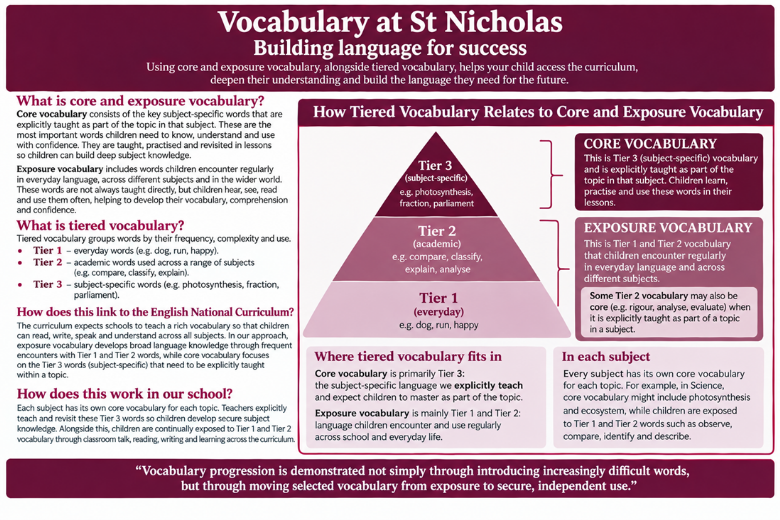
Vocabulary
Assessment
At St Nicholas, assessment is an integral part of our teaching of reading. We use assessment to identify children’s strengths, track progress and recognise where additional support or challenge is needed.
Teachers use daily formative assessment to check children’s understanding, fluency, vocabulary and comprehension during reading lessons. Children’s progress is also assessed more formally at regular points throughout the year. This includes Testbase assessments, Salford Reading Tests and Read Write Inc. assessments, alongside ongoing teacher assessment.
Assessment information is used to identify children who may need additional support. Where appropriate, children receive targeted interventions in phonics, reading fluency or comprehension, with progress carefully monitored. Our approach follows an assess–plan–do–review cycle so that support is responsive to each child’s needs.
We work closely with parents and carers to support children’s reading beyond school. Children take home appropriately matched reading books, and families are encouraged to read regularly together, discuss books and develop a love of reading for pleasure.
Enrichment and Cultural Capital
We believe that developing a love of reading extends far beyond the reading lesson. Throughout their time at St Nicholas, children have opportunities to meet authors and poets, attend theatre visits, take part in competitions and celebrate literature through whole-school events.
Our reading enrichment includes:
- Reading Cafés
- Author visits
- Poet visits
- Poet Laureate Competition
- Book Club
- Journalism Club
- Theatre visits
- World Book Day
- National Poetry Week
- National Storytelling Week
- Leeds Book Awards
- British Library learning live streams
- Scholastic Book Fair
- Tiny Tales
- Konflux
- School library boxes
These experiences provide children with opportunities to encounter literature in different ways, develop cultural capital and understand that reading is an important part of life beyond the classroom. Our Reading Cafés, for example, provide a welcoming social environment where children explore new books, share recommendations and talk about what they enjoy reading.
Reading across the Curriculum
Reading is central to learning across the whole curriculum. We carefully select high-quality texts that support children in developing subject knowledge as well as their reading skills.
Children encounter a wide range of story and information texts, poetry and non-fiction throughout their time at St Nicholas. These texts introduce children to new vocabulary, ideas and experiences while supporting them to develop their knowledge and understanding across different subjects.
Our Reading Spine provides a rich collection of high-quality texts which act as a stimulus for learning, broaden children’s experiences and create meaningful links across the wider curriculum. Reading also takes place through class libraries, book corners, guided reading, whole-class texts and books linked to curriculum learning.
Poetry is an important part of this provision. Each half term, every class spends one week using a poem as their fluency text, ensuring that children experience a broad range of high-quality poetry alongside fiction and non-fiction.
Pupil Voice
Children at St Nicholas value the opportunities they have to read, share books and talk about literature. They enjoy choosing books, reading with their friends, taking part in Book Club and experiencing reading through events and enrichment opportunities.
Our pupils recognise that reading is not only important within lessons but also provides opportunities to explore new ideas, discover different authors and genres and enjoy stories together.
“I love World Book Day because we get to dress up as our favourite book characters”. - Year 1 pupil
“I really enjoyed the Reading Café because we got to share books and talk about stories together.- Year 2 pupil
“I enjoy when we do Book Club because I can read with my friends and talk about books we like. Me and my friends sometimes share books we know we’d like to read.”- Year 3 pupil
“Our teachers help us to choose books that are right for us and encourage us to try different authors and genres.”- Year 4 pupil
“There are lots of different opportunities to use English outside of lessons, like Book Club, poetry competitions and visits. It shows us that reading and writing are useful beyond the classroom.” - Year 5 pupil